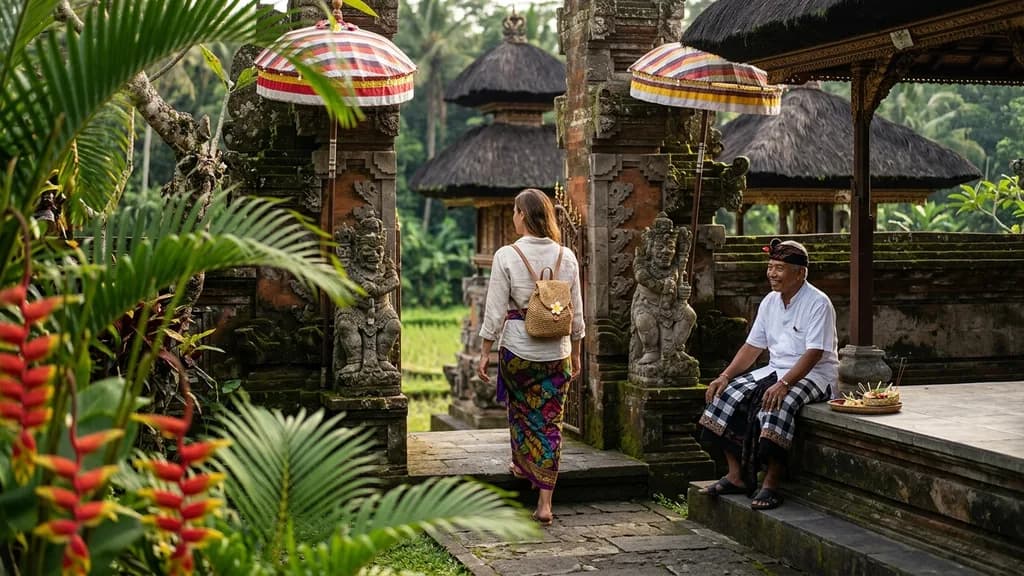
Bali Cultural Etiquette: What to Wear, Tip, and Avoid (2026 Guide)
Bali Cultural Etiquette: What to Wear, Tip, and Avoid (2026 Guide)
Heading to Bali and worried about accidentally offending someone? You're not alone — every week, travel forums fill up with the same anxious questions: Can I wear red? Is it OK to hold hands with my partner? Do I tip the driver? What do I wear to a temple? The good news is that Balinese culture is famously warm, forgiving, and welcoming to visitors who make even a small effort. The bad news is that misinformation runs wild online, and a lot of "rules" people repeat are either outdated, misunderstood, or flatly wrong. This 2026 guide cuts through the noise with clear, practical etiquette advice for U.S. and European travelers visiting Ubud, Canggu, Seminyak, Kuta, and beyond.
Key Takeaways
| Topic | What you actually need to know |
|---|---|
| Dress code (general) | Casual is fine in tourist areas; cover shoulders/knees at temples and traditional villages. |
| Public affection | Holding hands and quick kisses are tolerated in tourist zones; full PDA is rude near temples or in villages. |
| Tipping | Optional, not obligatory. 10,000-50,000 IDR (~USD 0.65-3.30) per service is generous. |
| Temple visits | Sarong + sash required (usually 10,000-20,000 IDR rental); remove hats; no entry while menstruating (traditional). |
| Wearing red | Totally fine — red is common in offerings and ceremonies. The "avoid red" rumor is a myth. |
| Left hand | Considered unclean. Eat, pay, and hand objects with your right hand. |
1. The red clothing myth — what's actually true?
If you've Googled "can I wear red in Bali" you've probably seen contradictory advice — some travel blogs warn you'll offend the gods, others say it's fine. Here's the reality: wearing red in Bali is completely acceptable. Red is everywhere in Balinese Hindu culture. Look at the canang sari offerings placed on sidewalks every morning — they're filled with red hibiscus, red chrysanthemums, and red rose petals. Red is associated with Brahma, the creator god, and with strength and protection. It's not a forbidden color; it's a sacred one.
So where does the rumor come from? A few sources:
- Balinese ceremonial clothing for participants in certain rituals leans toward white (purity) and gold (prosperity), not because red is banned but because each color carries meaning. Tourists confuse "ceremonial preference" with "tourist prohibition."
- Cremation ceremonies (ngaben) sometimes have specific dress codes — but these are events you'd only attend by invitation.
- Other Asian cultures (notably some Chinese contexts) treat red differently, and travelers blur the lines between Bali, Thailand, and China.
The bottom line: wear red shorts, red dresses, red bikinis, red sarongs — anything you want. The only color sensitivity you'll encounter is at funerals (avoid bright colors out of respect) and at temples (cover up, regardless of color). For day-to-day travel through Ubud markets or Seminyak beach clubs, you can wear whatever color you like.
Pro Tip: If you're attending a temple ceremony as a guest, ask your host what to wear. They'll usually loan you a proper sarong, sash, and white or light-colored shirt. Showing up prepared earns instant respect.
2. Public affection and body language
This is one of the most-asked questions on Reddit's r/bali — "can I kiss my girlfriend in Bali?" The honest answer: it depends entirely on where you are.
What's generally accepted
In the tourist heartlands — Canggu, Seminyak, Kuta, parts of central Ubud — you'll see plenty of couples holding hands, hugging, and exchanging quick kisses. No one bats an eye. Beach clubs, bars, and Western-style restaurants are essentially neutral zones where European and American norms apply.
What's not okay
- Heavy making-out in public — uncomfortable for locals, even in Canggu.
- Any PDA near temples or during ceremonies — deeply disrespectful.
- Affection in traditional villages (think rural Sidemen, Munduk, parts of East Bali) — keep it low-key.
- Topless sunbathing — technically illegal and culturally offensive, even on tourist beaches.
Body language to watch
Beyond romance, a few gestures matter:
- Don't point with your feet. Feet are considered the lowest, dirtiest part of the body. Don't put them on furniture, don't point them at altars or people, and tuck them under you when sitting on the ground.
- Don't touch anyone's head, including children. The head is the most sacred part of the body in Balinese Hindu belief.
- Pointing with a single finger is rude. Use your whole hand or thumb instead.
- Stepping over offerings (canang sari) placed on the ground is impolite — walk around them.
These aren't subtle distinctions locals will quietly resent; they're common knowledge among Balinese, and following them will earn you visibly warmer service.
3. Tipping culture in Bali (2026 rates)
Tipping in Bali is not obligatory the way it is in the United States — but it is appreciated, and Balinese service workers earn modest wages, so a small tip goes a long way. The biggest mistake U.S. travelers make is over-tipping (which can feel patronizing) or under-tipping out of confusion.
What to actually tip
| Service | Suggested tip (IDR) | USD equivalent | Notes |
|---|---|---|---|
| Restaurant waiter | 5-10% of bill | varies | Skip if a "service charge" (usually 10%) is already on the bill. |
| Driver (full-day) | 50,000-100,000 IDR | ~$3.30-6.50 | More for excellent service or long days. |
| Driver (Gojek/Grab short ride) | Round up | ~$0.50-1 | Optional — round to nearest 5,000. |
| Spa massage (1 hr) | 20,000-50,000 IDR | ~$1.30-3.30 | A small extra for a great massage is meaningful. |
| Tour guide (half-day) | 50,000 IDR | ~$3.30 | Per person; double for full day. |
| Hotel housekeeping | 10,000-20,000 IDR/day | ~$0.65-1.30 | Leave on pillow with a thank-you note. |
| Hotel porter | 10,000 IDR/bag | ~$0.65 | One-off on arrival/departure. |
| Surf instructor | 30,000-50,000 IDR | ~$2-3.30 | After a private lesson. |
Important rules
- Many mid-range and upscale restaurants add a "service charge" (usually 10%) plus a "government tax" (10%, called PB1). Look at the bottom of your bill — if "service" is listed, you don't need to tip on top.
- Tip in Indonesian rupiah, not USD. Foreign currency is awkward to exchange and feels impersonal.
- Don't over-tip. Handing a driver 500,000 IDR for a one-hour ride creates discomfort, not gratitude.
- A handshake and "terima kasih" (thank you) when handing over a tip carries enormous warmth.
Pro Tip: Keep a stash of 10,000, 20,000, and 50,000 IDR notes in a separate pocket. You'll be able to tip smoothly without breaking large bills.
4. Temple dress codes and spiritual etiquette
Bali has more than 20,000 temples (pura) — they're at the spiritual heart of the island, and entering one without respect is the single biggest cultural mistake tourists make. The good news: it's easy to do this right.
The basic dress code
- Sarong wrapped around the waist (covers legs to ankles).
- Sash (selendang) tied around the waist over the sarong.
- Shoulders covered — t-shirts are fine; tank tops and spaghetti straps are not.
- No hats inside the temple complex.
- Bare feet are sometimes required in inner sanctums; follow signage and watch what locals do.
At major temples — Tanah Lot, Uluwatu, Tirta Empul, Besakih, Ulun Danu Beratan — sarong and sash rentals are included in your entry ticket or available for 10,000-20,000 IDR. At smaller, off-the-beaten-path temples, bring your own.
The menstruation rule
This one surprises many Western women: traditionally, women who are menstruating are asked not to enter Balinese Hindu temples. The rationale is spiritual — bleeding is associated with impurity in a sacred space — and it's considered a mark of respect for the goddesses, not an insult to women. Signs at temple entrances often state this explicitly.
There's no checkpoint, no enforcement; it's an honor-system rule. Most Western women on their period choose to skip temple visits out of respect. If you're unsure, you can simply tell the temple guard at the entrance — they'll appreciate your honesty and may suggest waiting outside while your group enters.
Photo etiquette inside temples
- Look for "no photography" signs — they exist in many inner sanctums.
- Never climb on temple structures for a photo. Drone footage of temple ceremonies has caused real outrage.
- Don't pose flippantly in front of altars. Yoga poses, peace signs, and "boyfriend-of-Instagram" routines feel disrespectful in sacred spaces.
- Wait until after the ceremony to take photos of priests or worshippers.
5. Dining and gesture taboos
Balinese dining culture is informal and warm, but a few small habits will mark you as either respectful or oblivious.
The left-hand rule
In Bali (and across Indonesia), the left hand is traditionally considered unclean — historically used for personal hygiene, before modern plumbing. As a result:
- Eat with your right hand (or with utensils — left-handed utensil use is fine, but pure-finger food should be right-handed).
- Pay and accept change with your right hand.
- Hand objects to people with your right hand, or with both hands for extra respect.
- Don't gesture or wave with your left.
Locals know foreigners aren't culturally trained in this, so they won't openly correct you, but they'll notice the difference if you get it right.
Other table notes
- Don't start eating before the host invites you. "Silakan makan" means "please eat."
- Saying "terima kasih" (thank you) at the start and end of a meal is appreciated.
- Sharing food family-style is the norm — don't be territorial about your plate.
- Burping is not a compliment in Bali (unlike in some other Asian cultures); cover your mouth.
Stepping over offerings (canang sari)
Every morning, Balinese place small woven palm-leaf baskets filled with rice, flowers, incense, and sometimes a coin or candy on sidewalks, doorways, and shrines. These are canang sari — daily offerings to the gods. Don't step on them. Don't kick them. Walk around them, even if they're in awkward spots. If you accidentally step on one, a quiet apology is enough; no need to over-react. Locals understand.
6. Photos, ceremonies, and respect
Bali is one of the most photogenic places on earth, but there are clear lines around when and what to photograph.
Always ask first
- Photographing locals up close: ask. A smile and a gesture toward your camera works fine. "Boleh foto?" means "Can I take a photo?"
- Photographing children: ask the parent.
- Photographing market vendors: buy something small first — it transforms the moment from extraction to exchange.
Times to put the camera away
- Cremation ceremonies (ngaben): highly spiritual, emotionally charged, and often closed to outside photography. If you're invited as a guest, ask the family before raising your phone.
- Temple ceremonies in progress: some are open, others are private. Always check with locals first.
- Inside trance dances or sacred performances — wait for a clear "yes."
- Drones near temples or ceremonies — almost always inappropriate without explicit permission.
Posing respectfully
Tourists posing nude or semi-nude at sacred sites have made international news multiple times — and have been deported. Don't be that person. Bali takes its sacred geography seriously. Mount Agung, the major temples, the cliffs at Uluwatu — these are all spiritually significant. Photograph them with the same respect you'd photograph a cathedral.
7. Bali-specific holidays to know
The Balinese calendar is rich with ceremonies. A few are big enough to affect your trip directly.
Nyepi — the Day of Silence
Nyepi is the Balinese New Year, observed each March (the 2026 date is March 20). It is the single most disruptive day in Bali for travelers — and also one of the most fascinating cultural experiences anywhere on earth.
For 24 hours:
- The entire island shuts down. No flights in or out of Ngurah Rai International Airport.
- No driving. No motorbikes, no taxis, no Gojek.
- No working, no entertainment, no fires, no lights after dark.
- Tourists must stay inside their hotel or villa. You can use the pool quietly during the day, but stepping onto the street is forbidden.
- Wi-Fi and cellular data are often shut off.
The Pecalang (traditional security) patrol the streets to ensure compliance. The night before Nyepi features the famous Ogoh-Ogoh parades, where giant demon effigies are paraded and burned. The day after is Ngembak Geni, when normal life resumes.
If you're in Bali for Nyepi, plan for it: stock up on snacks, books, and entertainment. Most hotels prepare special meals. Many travelers who've experienced it say it was the highlight of their trip.
Galungan and Kuningan
Galungan (every 210 days on the Pawukon calendar) celebrates the victory of dharma over adharma — good over evil. Kuningan falls 10 days later, marking the close of the celebration period. During these days:
- Tall bamboo poles (penjor) decorated with palm leaves and offerings line every street — stunning to see.
- Family ceremonies dominate; many businesses have reduced hours.
- Temples are extremely busy with worshippers.
These are great times to visit — the island feels alive and decorated — but expect slower service and limited reservations.
Other holidays to know
- Saraswati Day — the day of knowledge; books and computers are blessed.
- Pagerwesi — a day of spiritual fortification.
- Tumpek Landep — metal objects (including motorbikes) are blessed.
8. Dress expectations outside the beach
A common point of friction: tourists wandering through restaurants, shops, and even temples in nothing but a bikini or board shorts. In tourist areas, this is technically tolerated; culturally, it's considered tacky and disrespectful.
What to wear where
| Setting | Acceptable | Not acceptable |
|---|---|---|
| Beach / pool / beach club | Swimwear, board shorts, bikinis | — |
| Walking the street (Canggu, Seminyak) | Cover-up + swimwear, casual clothes | Bikini-only, shirtless men |
| Restaurants and cafes | Casual but covered | Wet swimwear, no shirt |
| Shops and markets | Casual clothes | Bikinis, very short shorts |
| Temples / ceremonies | Sarong + sash + covered shoulders | Anything revealing |
| Traditional villages | Modest clothes, knees and shoulders covered | Beachwear |
A simple rule: if you're more than one block from the sand, throw on a cover-up. Light sarongs sold everywhere for 30,000-80,000 IDR double as both temple-wear and street cover-ups — buy one your first day.
9. Common mistakes US/European travelers make
After hundreds of forum threads and traveler debriefs, the same mistakes keep coming up. Avoid these:
- Riding a scooter without a helmet (or a license). Police checkpoints fine tourists hundreds of thousands of rupiah, and accidents are the leading cause of tourist injury in Bali. Always wear a helmet, always carry your International Driving Permit.
- Treating the Balinese as background characters in your vacation video. Locals appreciate eye contact, a smile, and a basic "terima kasih." The transactional, head-down tourist attitude lands poorly.
- Bargaining aggressively at markets over pennies. Negotiation is normal, but driving down a price by 5,000 IDR (about USD 0.30) feels mean-spirited. Pay fairly.
- Posing inappropriately at sacred sites. Topless, nude, or trivializing photoshoots at temples or Mount Agung have led to high-profile deportations. Don't risk it.
- Ignoring Nyepi. Showing up at the airport on the Day of Silence — yes, people still try this — means a full day of disruption. Check the date before booking.
- Wearing shoes inside homes or some shops. When in doubt, look at the entrance. If shoes are lined up outside, take yours off too.
10. Cultural sensitivity during Ramadan
Here's a useful nuance most travel guides miss: Bali is over 90% Hindu, while Indonesia as a whole is over 87% Muslim. This means Ramadan has a much smaller impact in Bali than in Java, Lombok, or other Indonesian islands.
What to expect in Bali during Ramadan
- Restaurants, bars, and beach clubs operate normally. No widespread daytime closures.
- Most service workers are Hindu Balinese, not fasting.
- Some Muslim staff (especially in resorts hiring from Java) may be fasting — be considerate, and don't make a show of eating in front of them if it can be avoided.
- Eid al-Fitr (Lebaran) at the end of Ramadan is a major holiday; expect packed beaches as Indonesian families travel and crowded flights for about a week.
If you're traveling beyond Bali
If you're heading to Java, Lombok, or the Gili Islands during Ramadan, the etiquette tightens:
- Avoid eating, drinking, or smoking in public during daylight hours as a courtesy to those fasting.
- Dress more conservatively than you would in Bali — covered shoulders and knees as a default.
- Live music and alcohol may be restricted in some areas during the holy month.
Lombok in particular feels noticeably different from Bali — quieter daytimes, livelier nights once the fast breaks at sunset.
Verder lezen
Frequently Asked Questions
Can I wear red in Bali?
Yes, wearing red in Bali is perfectly acceptable and very common — many temple offerings use red colors. The old 'avoid red' rumors come from Balinese Hindu ceremonies where certain specific ritual contexts favor white or ceremonial colors. For daily tourism, red clothing is fine.
Is it okay to kiss my girlfriend in Bali?
Light public affection (holding hands, quick kisses) is generally tolerated in tourist areas like Kuta, Canggu, and Seminyak. In traditional villages, around temples, or in Ubud's spiritual zones, avoid any public displays of affection — it's considered disrespectful.
Do you tip in Bali?
Tipping is not expected but appreciated. For restaurants, many include a 10% service charge; if not, 5-10% is a kind gesture. For drivers, massages, and guides, 10,000-50,000 IDR (~USD 0.65-3.30) per service is appreciated. Never tip excessively — it can embarrass.
What should I wear to Bali temples?
Cover shoulders and knees (sarong + sash provided at most major temples, usually 10,000-20,000 IDR rental). Women who are menstruating traditionally should not enter — this is a spiritual rule, not enforced but respected. Remove hats inside temple complexes.
Is it rude to use my left hand in Bali?
Yes — the left hand is considered unclean (used for personal hygiene traditionally). Eat, give money, and hand objects with your right hand. When giving something, using both hands shows extra respect.
Can I take photos of ceremonies and locals?
Always ask permission first. Balinese are generally friendly about photos but some ceremonies (especially cremations and spiritual rituals) should never be photographed without explicit consent. Temple interiors often have photo restrictions — look for signs.
What about drinking alcohol in Bali?
Alcohol is legal and widely available. However, avoid public drunkenness — Balinese culture values self-control. During major Hindu holidays like Nyepi (Day of Silence), alcohol sales are restricted island-wide.
Are swimsuits okay outside the beach?
On the beach: yes. Walking through Canggu or Seminyak streets in only swimwear: technically accepted in tourist areas but considered impolite. Always wear a cover-up in restaurants, shops, or anywhere not directly beach-adjacent.
Sources & References

Go2Bali Team
Travel Writer at Go2Bali
- ●Bali travel experts
- ●Locally verified information
- ●Regular content updates
The Go2Bali team shares local insights, practical travel tips, and in-depth guides to help you explore Bali like a seasoned traveler.
More about usPlan Your Bali Trip
Book hotels, tours, and transport through our trusted partners and get the best deals for your Bali adventure.