When Is the Worst Time to Visit Bali? Honest Months to Avoid (2026)
When Is the Worst Time to Visit Bali? Honest Months to Avoid (2026)
Welcome to go2-bali.com. Most blogs will sell you on the "best time to visit Bali" — endless promises of sunshine, surf, and rice-terrace bliss. We're flipping that script. If you only have one shot at a Bali trip, knowing when not to come matters more than knowing when to come. Bad timing turns a dream vacation into a soggy, gridlocked, overpriced slog.
The short, honest answer to "when's the worst time to go to Bali": January and February (peak wet season — flooding, mold, cancelled boats), mid-July through August (brutal Australian-school-holiday overcrowding and doubled prices), and Nyepi day (a single date in March when the entire island — airport included — shuts down for 24 hours). Christmas/New Year is also miserable if you want calm and affordable.
Per the U.S. Department of State's International Travel Information Pages for Indonesia (travel.state.gov), Indonesia is at Level 2: Exercise Increased Caution, with weather-related travel disruptions noted seasonally. Enroll in STEP before your trip and check id.usembassy.gov for current advisories — wet-season flooding regularly affects roads to and from Ubud, Canggu, and Uluwatu.
This guide is brutally honest. We won't pretend "every season has its charms" if your specific charm is "no rain on my snorkeling day."
Key Takeaways: Worst Months at a Glance
| Month / Period | Main Problem | Severity |
|---|---|---|
| January | Heaviest rainfall, flooding, ferry cancellations to Nusa islands | High |
| February | Rain continues, mold in budget rooms, wettest beach clubs closed | High |
| March (Nyepi day) | 24-hour total island shutdown including airport | Critical (1 day) |
| Mid-July to end of August | Peak crowds, doubled prices, gridlocked roads | High |
| December 20 – January 5 | Christmas/NYE peak prices, party noise everywhere | Medium-High |
| April / October | Surprise rain, transitional weather (less predictable) | Low-Medium |
| Galungan / Kuningan (variable) | Cultural sites very busy, some closures | Low |
| Ramadan | Minimal impact in Hindu Bali (vs. Java/Lombok) | Very Low |
If your trip overlaps any "High" or "Critical" period and your dates aren't fixed, shift them. Read on for the why.
1. January–February — The Wet Season Peak (Real Problems)
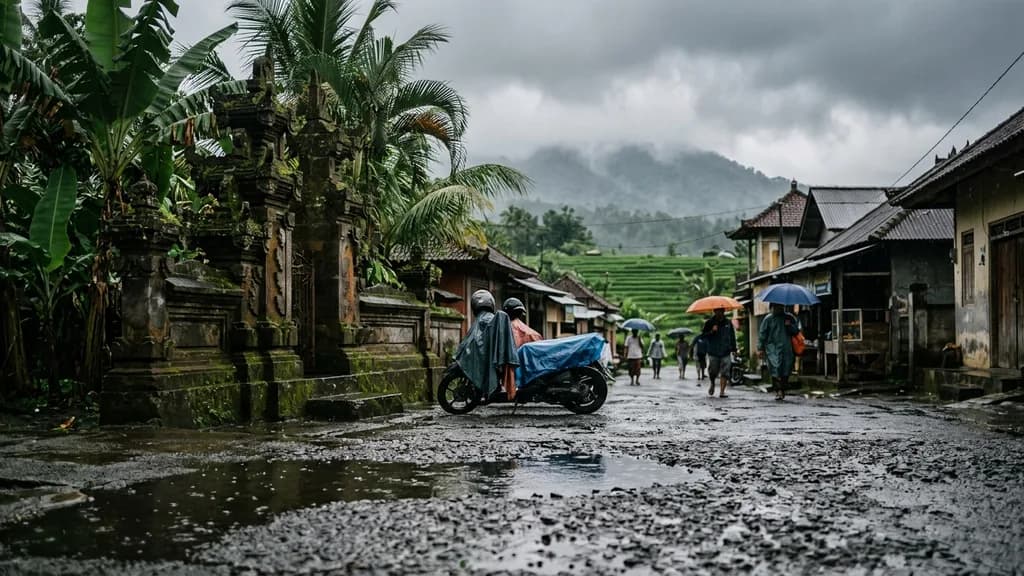
This is the rainiest stretch of the year in Bali. Not "occasional showers" — actual monsoonal rain.
What "wet season" really means
Bali's wet season runs roughly November to March, but January and February are the peak. Average rainfall in January hits 300–400 mm spread over 25–28 rainy days. February is almost as bad. Most rain falls in heavy afternoon/evening tropical storms, so you do still get clear mornings — but multi-day rain stretches happen, and they crush activity-heavy itineraries.
The real downsides nobody markets
- Flooding: Roads in Canggu, Seminyak, and lower Ubud flood after heavy rain. Transfers that normally take 40 minutes can stretch past 2 hours. Scooters become dangerous on flooded streets.
- Mold and damp: Budget guesthouses and villas without air-conditioning develop visible mold on walls, mattresses, and clothes left in cupboards. If you're booking under $30 USD/night, ask the host directly about wet-season conditioning before paying.
- Cancelled fast-boats to Nusa Penida and the Gili Islands: Rough seas regularly cancel morning departures. If you've planned a Penida day trip, you may lose the day entirely. Operators often won't refund if "weather permits later."
- Beach erosion: West-coast beaches like Kuta, Legian, and Canggu pile with monsoon debris — plastic from upstream rivers, driftwood, and a brown algal slick on bad days. Photos look nothing like Instagram.
- Lightning storms: Bali sees serious electrical storms. Outdoor activities — sunset cliffs at Uluwatu, beach clubs, paragliding — get cancelled with little warning.
- Dengue risk uptick: Standing water increases mosquito breeding. The Indonesian Ministry of Health typically reports higher dengue cases January–April. Repellent with DEET 25%+ is non-negotiable.
Who can still enjoy January–February
Wet season works for deal-hunters (rooms 25–40% cheaper than peak), photographers (rice terraces are blindingly green), and digital nomads in covered cafes. It does not work for: surf-trip-only travelers heading to west-coast breaks, Nusa Penida day-trippers, or anyone with a tight 5-day itinerary that can't absorb a washed-out day.
Pro Tip: If you must visit January–February, base in Ubud (rice paddies look their best when wet) or east coast Sanur and Amed — the eastern side gets noticeably less rain than the southwest.
2. July–August — Crowded Chaos
The weather is genuinely perfect: dry, breezy, 27–30°C / 80–86°F, low humidity for Bali standards. That's exactly why everyone shows up.
Why it's crowded
Three waves collide:
- Australian school holidays (mid-June to mid-July, then late September). Australia is Bali's #1 source market.
- European summer break — Germans, French, Dutch, British arrive on long flights for 2–3 week stays.
- North American summer travelers taking the once-a-year long trip.
Result: Bali receives roughly twice as many tourists in July–August as in January–February, all packed into the same southern strip from Canggu to Uluwatu.
The actual pain points
- Hotel prices double — sometimes triple for popular Canggu and Seminyak villas. A villa that's $120/night in February may hit $280–350 in August.
- Restaurant booking lead times explode. Popular spots in Canggu, Seminyak and Uluwatu need 2–4 week advance reservations. Walk-ins get a 90-minute wait or worse.
- Road traffic is horrendous. The single-lane coastal road from Kuta to Uluwatu becomes a 2-hour crawl in late afternoon. Scooter-only routes fill with inexperienced rental tourists, increasing accident rates.
- Beach club entry minimums climb. Day-bed reservations at Finn's, Potato Head, La Brisa often require 1.5M IDR (~$95 USD) minimum spend in peak weeks vs.
700K ($45) off-peak. - Diving and surfing crowded. Lineup at Uluwatu in August: 80+ surfers competing for the same takeoff zone. Aggression, drop-ins, and gear damage spike.
- Airport queues. Ngurah Rai Denpasar arrivals hall: 90-minute immigration waits in peak August. Bring patience and water.
Australian school-holiday dates worth checking
Australian states have slightly different term dates. The worst overlap weeks are typically the final week of June through the third week of July, plus the final week of September (spring break). If you can travel either side of these windows, do.
When August still works
If you specifically want dry surf at Uluwatu, the dry firework-clear sunsets, or the party scene — August delivers. Just go in expecting Times-Square density and Manhattan prices.
3. Nyepi Day — The Complete Island Shutdown
This is the single most under-warned hazard for first-time Bali visitors. Nyepi ("Day of Silence") is the Balinese Hindu New Year, and the island shuts down completely.
When Nyepi falls
Nyepi follows the Balinese Saka calendar — the date changes annually and falls in March. Nyepi 2026 is on Saturday, 21 March 2026. Always verify the date before booking March travel; in some years it lands in early April.
What "shutdown" actually means
For a full 24 hours (6am to 6am):
- Ngurah Rai Denpasar Airport closes. No arrivals, no departures, no transit. The only airport in Asia that closes for a religious holiday.
- All seaports close — no fast boats, no ferries to Java, Lombok, Nusa Penida or the Gilis.
- No driving — locals included. Scooters, cars, taxis, buses all parked. Even ambulances need special permits.
- No outdoor lights after dark. Curtains drawn, candle-only inside.
- No fires — including cooking. Resorts serve cold/pre-prepared meals only.
- No internet — mobile data is officially shut down by Indonesian providers. Some resort Wi-Fi works but unreliably.
- Pecalang (traditional Balinese security) patrol streets and will turn back anyone walking outside.
Why this matters for your trip
If your arrival or departure flight falls on Nyepi, you're stuck. The day before Nyepi is Melasti (purification ceremonies — beaches packed with offerings) and the day before that is Tawur Kesanga with massive Ogoh-Ogoh parades. The day after Nyepi (Ngembak Geni) services slowly restart but airport delays continue.
Practical impact: a 5-day trip that includes Nyepi loses one full day to mandatory hotel confinement, and potentially another to airport disruption. On a short trip, that's 40% of your time gone.
When Nyepi is actually amazing
If you're already settled in a comfortable hotel, Nyepi is the most unique cultural experience in Asia. The night sky over Bali on Nyepi is one of the few truly dark skies left in populated Asia — the Milky Way is visible from rooftop pools. The silence is genuinely surreal. The Ogoh-Ogoh parade the night before features massive demonic effigies built by each village.
Pro Tip: If you want the experience without the airport gamble, arrive 3 days before Nyepi, leave 3 days after. Stay in a mid-range or higher resort that pre-prepares Nyepi meals (most do). Avoid bare-bones guesthouses that may not stock food.
4. Christmas and New Year — Prices at Annual Peak
December 20 through January 5 is the single most expensive window of the year in Bali, often pricier than even peak August.
What happens
- Russian, European, and Australian holidayers descend simultaneously.
- Hotel rates 2–3× normal. A standard $150/night Seminyak villa often sits at $400–500.
- Beach clubs charge ticketed entry for NYE parties — Finn's, Potato Head, Ku De Ta, Omnia run $150–350 USD packages, often sold out by October.
- Restaurants impose set NYE menus at $80–200 per head, no à la carte.
- Airport chaos rivaling August — expect 2-hour immigration on arrival.
- Weather is wet-season — so you're paying peak prices for second-tier weather.
When Christmas/NYE works
If you want the party — Bali's NYE scene is genuinely world-class — and you've booked 4–6 months in advance, it's a memorable experience. Otherwise, this window combines all the downsides of high season with all the downsides of wet season.
5. Galungan and Kuningan — Religious Busy-Periods (Minor)
Galungan celebrates the victory of dharma over adharma; Kuningan falls 10 days later. These are the most important Balinese Hindu holidays after Nyepi. Like Nyepi, dates change annually based on the 210-day Pawukon calendar (so Galungan happens roughly twice in some calendar years).
Practical impact (much milder than Nyepi)
- Streets lined with penjor — beautiful tall bamboo poles with offerings. Photogenic, not disruptive.
- Locals travel home to villages — meaning some warungs, drivers, and small businesses close 1–2 days.
- Family temples and major sites (Besakih, Tirta Empul, Ulun Danu) are extremely busy with Balinese worshippers. Tourists are welcome but expected to dress modestly and yield space.
- Tourist infrastructure runs normally — flights, hotels, restaurants, beach clubs all open.
Verdict
Galungan/Kuningan is not a bad time to visit. It's actually one of the best cultural windows. Just don't expect a quiet Besakih or empty rice terraces those weeks.
6. Humidity Month-by-Month (Table)
Humidity is the silent ruiner of Bali trips for travelers from temperate climates. Even in "dry season" you're at 70%+ — and wet season pushes 85–90%.
| Month | Avg Temp | Avg Humidity | Rain Days | Comfort for Non-Acclimated Visitors |
|---|---|---|---|---|
| January | 27°C / 81°F | 86% | 25 | Sticky-hot, frequent storms |
| February | 27°C / 81°F | 85% | 22 | Sticky-hot, slightly drier |
| March | 27°C / 81°F | 83% | 18 | Improving, still humid |
| April | 28°C / 82°F | 80% | 12 | Acceptable for most |
| May | 28°C / 82°F | 78% | 7 | Good — sweet-spot month |
| June | 27°C / 81°F | 75% | 5 | Excellent |
| July | 26°C / 79°F | 73% | 4 | Best of the year (cool nights) |
| August | 26°C / 79°F | 72% | 3 | Best of the year |
| September | 27°C / 81°F | 75% | 5 | Excellent |
| October | 28°C / 82°F | 79% | 10 | Heating up |
| November | 28°C / 82°F | 83% | 17 | Sticky returns |
| December | 27°C / 81°F | 85% | 22 | Sticky-hot, holiday crowds |
Practical humidity advice
- Pack linen, lightweight cotton, or technical fabrics. Polyester traps sweat.
- Plan indoor or pool breaks 12pm–3pm — heat-stroke risk is real for first-day arrivals.
- Hydrate aggressively. 3–4 litres of water per day is normal in wet season.
- Hair, skin, and electronics suffer. Bring silica packets for camera gear.
7. Surfing: When Each Coast Is Worst
This is the single most-asked question on r/bali and surf forums, so let's nail it.
The basic geography
- West and southwest coasts (Canggu, Kuta, Uluwatu, Bingin, Padang Padang): face the Indian Ocean. Best in dry season (May–October) when southeasterly trade winds blow offshore.
- East coast (Sanur, Nusa Dua, Keramas, Amed): face east. Best in wet season (November–April) when westerly winds blow offshore here.
So when is each coast at its WORST?
| Coast | Worst Months | Why |
|---|---|---|
| Uluwatu / Bingin / Padang | November–February | Onshore winds blow chop, makes faces unrideable |
| Canggu (Batu Bolong / Echo) | December–February | Onshore wind, brown water from river runoff |
| Kuta beach break | January–February | Storm surf + debris + onshore wind |
| Sanur reef | June–August | Offshore wind only mornings; afternoons go flat |
| Nusa Dua | June–August | Same — east-coast spots underperform when west is firing |
| Keramas (east) | July–August | Crowded with pros chasing the only good east summer break |
The mistake to avoid
Booking a 7-day surf trip to Uluwatu in January. You'll get 1–2 surfable mornings out of 7. Switch your base to Sanur or Keramas in wet season and you'll surf almost daily.
Pro Tip: If your dates are locked but the wrong coast is on, rent a scooter and chase the offshore side. A 45-minute scooter ride from Canggu to Sanur is the difference between a blown-out day and a session. Don't be loyal to your accommodation's beach.
8. Diving: Amed and Lovina Visibility by Month
Diving conditions follow a different rhythm than surfing — visibility, current, and marine-life appearance all swing seasonally.
| Month | Amed Vis | Lovina Vis | Mola Mola | Manta Rays | Worth diving? |
|---|---|---|---|---|---|
| January | 5–10 m | 5–10 m | No | Some | Low — runoff cuts visibility |
| February | 8–15 m | 8–15 m | No | Some | Improving |
| March | 12–20 m | 12–20 m | No | Yes | Good |
| April | 15–25 m | 15–25 m | No | Yes | Excellent |
| May | 20–30 m | 20–30 m | No | Yes | Excellent |
| June | 25–30 m | 20–25 m | Starting | Yes | Excellent — peak start |
| July | 25–30 m | 20–25 m | Peak Mola | Yes | Best diving of year |
| August | 25–30 m | 20–25 m | Peak Mola | Yes | Best diving — but cold (22°C) |
| September | 20–30 m | 20–25 m | Tail end | Yes | Excellent |
| October | 15–25 m | 15–20 m | No | Yes | Good |
| November | 10–20 m | 10–15 m | No | Some | Declining |
| December | 5–15 m | 5–15 m | No | Some | Low |
Worst diving months
December–February for everything: river runoff at the USAT Liberty wreck (Tulamben near Amed), low visibility at Menjangan, rough seas making boat dives uncomfortable. Mola Mola (oceanic sunfish) season at Nusa Penida is strictly July–October — book accordingly.
9. Cheap Shoulder-Seasons Worth Considering
Now the contrarian flip: when "worst time" is actually a smart choice.
Late October to mid-November
- Wet season just starting — most days still dry.
- Hotel prices drop 30% from August levels.
- Crowds gone after European school year resumes.
- Diving still excellent.
- Surfing transitioning — west still works, east starting.
- Risk: occasional early storms.
Late February to mid-March (BEFORE Nyepi)
- End of peak rain — still wet but lighter.
- Cheapest hotel rates of the entire year — sometimes 50% off August.
- Rice terraces at peak green.
- Diving improving rapidly.
- Risk: Nyepi date — book accommodation that brackets it intentionally.
Late April to early May
- Wet season ending decisively.
- Crowds still light pre-summer.
- Pre-peak surf swells starting.
- Pre-peak prices.
- Considered the single best value window by many repeat visitors.
Early September
- Australian crowds gone.
- Weather still excellent.
- Slight price drop from August.
- Diving still peak Mola.
10. Contrarian: When "Worst" Time Actually Wins
Here's the honest reverse of the entire article: every "worst time" has a winning angle if your goals match.
January–February wins for:
- Photographers: green rice terraces, dramatic skies, fewer tourists in shots.
- Yoga retreaters in Ubud: covered studios don't care about rain, prices are 30% lower, energy is introspective.
- Wellness/digital nomad sabbaticals longer than 4 weeks — you'll still get plenty of sun.
- Couples on a quiet, romantic trip — beach clubs are mellow.
July–August wins for:
- Solo travelers wanting to meet people — every cafe and beach club is a social event.
- Surfers chasing west-coast world-class waves — Uluwatu fires only in dry season.
- Diving at Nusa Penida for Mola Mola — strictly summer.
- Festival-goers — major surf and music events stack in this window.
Nyepi wins for:
- Cultural travelers wanting a once-in-a-lifetime experience — the Ogoh-Ogoh parade is genuinely spectacular.
- Stargazers — Bali's only dark-sky night.
- Couples on retreat — forced disconnection beats any digital detox app.
Christmas/NYE wins for:
- Party travelers — world-class DJ lineups.
- Big-group friend trips with budget — villa rentals shine.
The takeaway: there's no universally bad time. There's only bad time for your specific goals. If you read this whole article and your dates still overlap a "worst" period — match your activity plan to what that period actually offers, instead of fighting it.
How This Connects to Your Itinerary
If you're still planning, three companion pieces help finalize:
- Trip length: Read How many days in Bali is enough? — short trips (5 days) are most vulnerable to bad timing because you can't absorb a washed-out day.
- Where to base: Nicest part of Bali to stay covers area selection, which interacts directly with seasonal weather (east vs west coast logic).
- Budget impact: Is $1000 enough for 1 week in Bali? — wet season can stretch that budget significantly; peak August often won't.
- Cultural calendar: Bali cultural etiquette — essential reading before Galungan/Kuningan/Nyepi.
Safety and Practical Notes
Per the U.S. Department of State (travel.state.gov), Indonesia carries Level 2: Exercise Increased Caution. Wet-season specific concerns:
- Flash flooding of rivers and roads — avoid driving in heavy rain, do not attempt to cross flooded roads on a scooter.
- Landslide risk in mountainous areas (Munduk, Kintamani, Bedugul) during sustained rain.
- Increased traffic accidents on wet roads — wear helmets, slow down, do not drive at night in storms.
- Volcanic activity at Mount Agung remains monitored year-round — check current status before booking sunrise climbs.
Enroll in STEP at step.state.gov for real-time alerts. The U.S. Embassy consular line is +62-21-5083-1000.
For medical emergencies, BIMC Hospital (Kuta and Nusa Dua) and Siloam Hospital (Denpasar) handle international patients. Confirm your travel insurance covers medevac to Singapore if needed — local hospitals are good for routine but limited for major trauma.
Final Verdict: Quick Decision Tree
- You have fixed January or February dates and want surf/snorkel/island-hop: Reschedule if at all possible.
- You have fixed January or February dates and want yoga/culture/budget: Go — you'll have a great trip.
- You're looking at March: Check the Nyepi date first. Bracket it with 3 days each side or skip the period entirely.
- You're looking at July or August: Book hotels and restaurants 3+ months ahead, expect 2× normal prices, and avoid Australian school-holiday peaks if you can.
- You're looking at December 20 – January 5: Only worth it for the party scene. Otherwise pick any other week.
- You're looking at late April, early May, late October, or early November: You found the sweet spots — book before everyone else figures it out.
Bali is a year-round destination if you match your trip to the season. It's a disaster if you don't. Choose with eyes open, and you'll come home raving instead of regretting.
For current advisories, contact the U.S. Embassy in Jakarta or visit travel.state.gov. Safe travels.
Verder lezen
Frequently Asked Questions
When is the worst time to visit Bali?
January-February: peak wet season with daily rain, flooding risks, mold in budget accommodations, and some beach clubs/activities closed. July-August: brutal overcrowding, hotel prices double, roads gridlocked. Nyepi day (March, variable date): full island shutdown including airport.
What's the rainiest month in Bali?
January, with average 300-400mm rain over 25-28 wet days. February is almost as wet. Even on rainy-season days, rain typically falls in afternoon/evening tropical storms, so mornings stay clear. But 10+ consecutive rainy days happen.
Is Nyepi a bad time to visit Bali?
If you're arriving on Nyepi day itself (variable date in March), yes — the airport closes, no driving allowed, shops/restaurants closed, and even resorts limit services (no lights outside, silent). If you arrive 1-2 days before or after, it's a cultural highlight.
Is August a bad time for Bali?
August is peak tourist season — Australian school holidays overlap with European summer. Expect: doubled hotel prices, 2-hour transfers that normally take 40 min, packed beach clubs, and 3-month advance booking needed for popular restaurants. Weather is great, crowds are brutal.
Should I avoid Bali during monsoon?
Not entirely — wet season (November-March) has 20-30% cheaper prices, green landscapes, fewer crowds, and afternoon rain rarely ruins full days. BUT: surfing the west coast (Canggu, Kuta, Uluwatu) is worse in wet season. Switch to east coast (Sanur, Nusa Dua) for better waves.
What about Christmas and New Year in Bali?
Very crowded with Western holidayers, hotel prices at annual peak, some beach clubs have massive ticketed NYE parties ($200+ entry). Pleasant if you want party atmosphere; miserable if you want calm. Book 4-6 months ahead.
What's the HUMIDITY like in Bali?
Year-round 75-85% humidity. Peak discomfort: November-March (wet season adds rain too). June-September is coolest and driest. First-time visitors from temperate climates often underestimate humidity — pack lightweight fabrics, plan indoor breaks.
Is Ramadan a bad time to visit Bali?
Bali is 90%+ Hindu, so Ramadan has minimal impact here — unlike Java/Lombok which are majority Muslim. You might see slightly fewer Javanese tourists and some restaurants respectful of local workers, but tourism continues normally.
Sources & References

Go2Bali Team
Travel Writer at Go2Bali
- ●Bali travel experts
- ●Locally verified information
- ●Regular content updates
The Go2Bali team shares local insights, practical travel tips, and in-depth guides to help you explore Bali like a seasoned traveler.
More about usPlan Your Bali Trip
Book hotels, tours, and transport through our trusted partners and get the best deals for your Bali adventure.